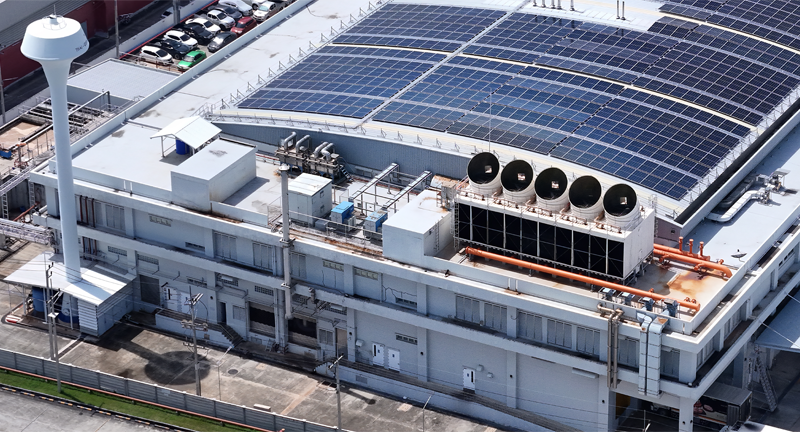
Data centers overtake offices in historic construction shift
Subscribe to our free newsletter today to keep up to date with the latest construction news.
A decisive reordering is underway in the US construction market. Data centers, once a niche segment tied to telecom expansion, have now overtaken office buildings in construction spending. The shift marks a turning point in how capital is deployed across the built environment, reflecting a deeper realignment of economic priorities toward digital infrastructure.
For decades, office towers served as a proxy for economic growth. Skylines expanded in tandem with corporate hiring and urban concentration. That relationship has weakened. Remote and hybrid work models have reduced demand for new office space, while vacancy rates remain elevated across major metropolitan areas. Developers and investors are responding by pulling back on office projects and redirecting funds elsewhere.
Data centers have emerged as the primary beneficiary. The scale of investment reflects the growing importance of compute capacity as a foundational asset class. Facilities that house servers, networking equipment, and storage systems are now treated with the same strategic weight once reserved for central business district developments.
AI, cloud computing and hyperscale demand reshape investment flows
The acceleration in data center construction is closely tied to the rapid expansion of artificial intelligence and cloud computing. Hyperscale operators, including major technology firms, are investing heavily in new capacity to support increasingly complex workloads. AI models require vast processing power, driving demand for specialized facilities capable of handling high-density computing environments.
This demand is capital intensive. Building and equipping a modern data center involves significant upfront expenditure, from land acquisition to cooling systems and power infrastructure. The return profile, however, is attractive for long-term investors. Lease agreements with large technology tenants tend to be stable, and utilization rates remain high as digital services continue to expand.
The result is a reallocation of billions of dollars into assets that support data processing rather than physical office occupancy. Construction pipelines reflect this priority. Regions with access to reliable power, favorable regulatory conditions, and connectivity infrastructure are seeing increased development activity. In many cases, competition among states and municipalities is intensifying as they seek to attract data center projects and the associated economic benefits.
The decline of office construction and changing real estate economics
The office sector is undergoing a prolonged adjustment. Demand has not returned to pre-pandemic levels, and many companies are reassessing their space requirements. Flexible work arrangements have reduced the need for large, centralized offices, leading to a surplus of available space in key markets.
This oversupply is influencing new construction decisions. Developers are cautious about initiating office projects without clear pre-leasing commitments. Financing has also become more constrained, as lenders reassess risk in a segment facing uncertain demand. The result is a slowdown in office construction starts and a growing gap between legacy assets and emerging needs.
At the same time, capital is flowing into sectors perceived as more resilient. Industrial, logistics, and data center properties are attracting investment due to their alignment with long-term structural trends. E-commerce growth, supply chain reconfiguration, and digital service expansion are all contributing to this shift. Office buildings, once the centerpiece of commercial real estate portfolios, are no longer the default destination for new capital.
Energy constraints and the limits of data center expansion
Despite strong momentum, data center growth is not without constraints. One of the most significant challenges is energy consumption. These facilities require substantial and continuous power, placing pressure on local grids and raising questions about sustainability.
Utilities and developers are working to address these concerns through a combination of strategies, including renewable energy sourcing, on-site generation, and efficiency improvements in cooling technologies. Even so, the scale of demand associated with AI workloads is testing existing infrastructure. In some regions, power availability is becoming a limiting factor for new projects.
This dynamic introduces a layer of complexity to future expansion. While demand for data center capacity remains robust, the pace of development may be influenced by the ability of energy systems to keep up. Policymakers, utilities, and private operators will need to coordinate closely to ensure that growth in digital infrastructure does not outstrip the resources required to support it.
The rise of data centers over office construction captures a broader transformation in the economy. Physical workplaces are no longer the primary drivers of construction activity. Instead, the systems that enable data creation, processing, and distribution are taking center stage, reshaping both skylines and investment strategies.
Sources:
Bloomberg